Quick-service chains like McDonald's, Subway, or full-service brands like Olive Garden may seem to dominate every street corner. Yet the data tells a different story: 90% of restaurants and cafés worldwide are independent or belong to small groups of 20 or fewer locations. Only 10% fall under larger groups.
In this article, we'll explore:
- Which countries have the highest share of restaurant groups and the factors shaping these markets
- The main types of groups and their global distribution
- Countries leading in the absolute number of restaurants belonging to a group
- Reservation platforms preferred by groups
Which countries have the highest share of restaurant groups and the factors shaping these markets
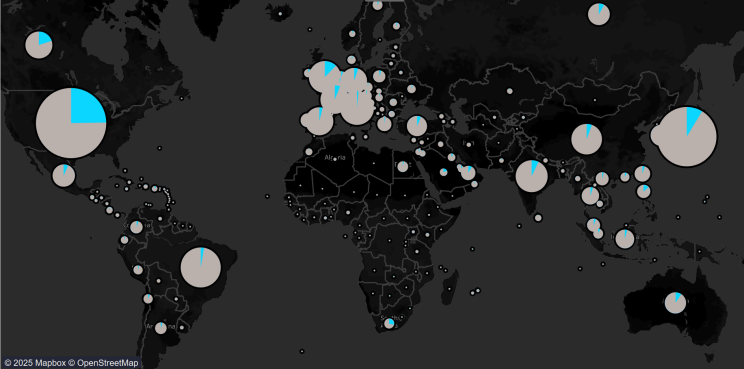
Distribution of restaurants by type of ownership: groups vs independent
Though they represent just 10% of the industry, restaurant groups play a major role in restaurant business. They are a reflection of a country's economic, cultural, and geographic factors. While the majority of restaurants are independent, some countries stand out with the percentage of restaurants in groups against the total number of restaurants in the country.
We will review the top 3 countries by share of group-owned restaurants below.
South Africa
South Africa tops the list with over 28% of the restaurants in the country belonging to a group. Domestic giant Famous Brands (Debonairs Pizza, Steers, Wimpy, Mugg & Bean, Fishaways, etc.) is the leader on the market. The US Yum! Brands (KFC, Pizza Hut) is the second largest, with local Spur Corporation coming third biggest company that owns restaurant groups.
South Africa's unusually high share of restaurant groups comes down to a mix of economic, cultural, and business factors. There are strong domestic holding companies, the market is franchise-friendly with a very mature franchising sector, not only in food but also in retail and services. Moreover, South Africans often see chains as more reliable in terms of food quality, safety, and consistency, especially in urban and suburban areas. All of these factors make South Africa a great place for restaurant franchises.
The United States
The US has the second largest share of restaurants in groups, with 25% of all restaurants in the country belonging to a group of 20+ restaurants. Being the pioneer of franchising, the US has many factors that set the groups to success. Legal frameworks, financing options, and franchising associations made it easy to replicate concepts across states. There is also a strong car culture that created demand for quick, affordable roadside dining options. Moreover, unlike some countries where international brands dominate, 98% of chains in the U.S. are domestic. This allows rapid expansion without heavy reliance on foreign groups.
Canada
Canada's high percentage of chain restaurants (20%) is driven by coffee culture (beloved Tim Hortons), cross-border U.S. influence, geography that favors standardization, and a strong franchising framework. Canada is a huge country with a dispersed population. Outside of big cities, chains provide reliable, familiar options where variety is limited. Travelers crossing provinces know what to expect from a McDonald's, Subway, or Tim Hortons — that predictability is highly valued.
The main types of groups and their global distribution
There are a few different types of restaurant/food establishments that chose to be a part of a group. In our research at analytics.restaurant we defined 8 types, and calculated how many are in the world. Below you can see the summary of these types, along with the number of restaurants in each category, along with percentage of total, definition, and top global leaders
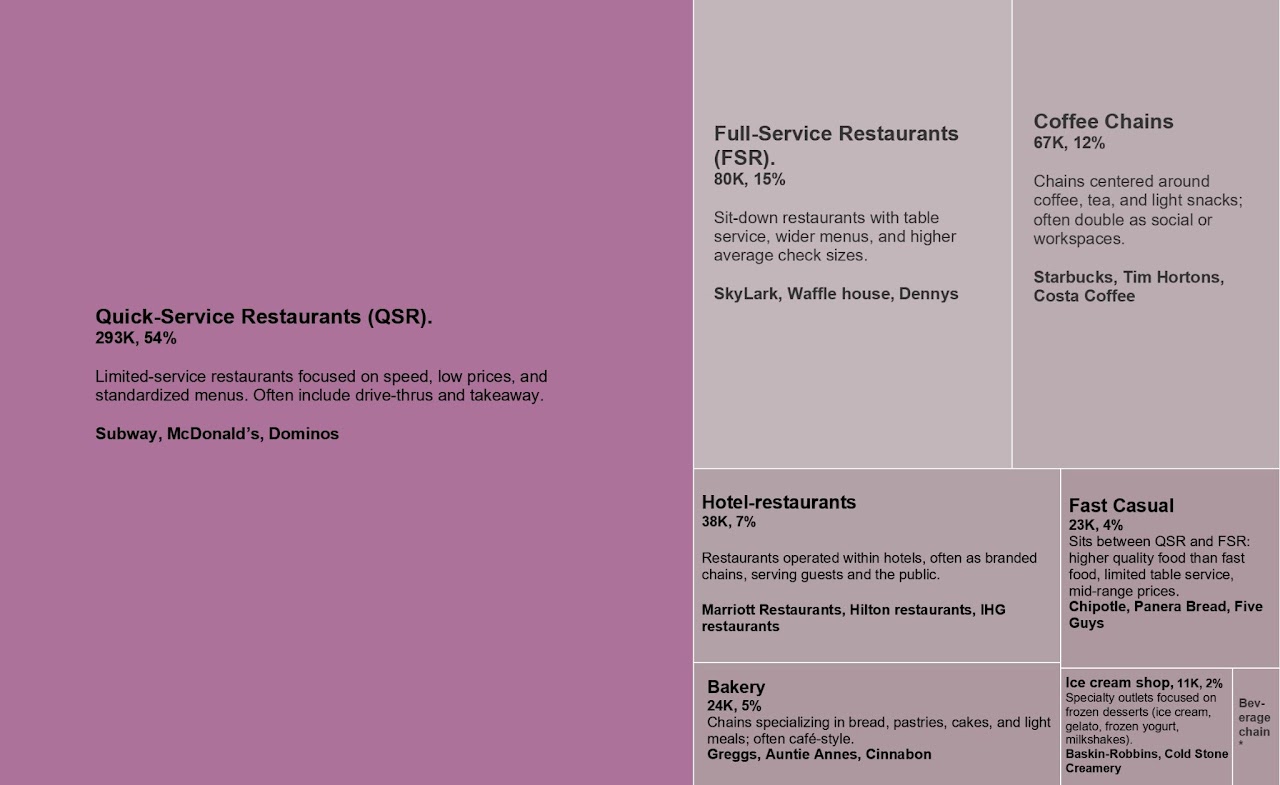
Types of groups, global snapshot with total number of restaurants, percentage of global total, definition, and top global leaders
Let's review the top 3 types.
Quick-Service (QSR).
- The majority (54%) of all restaurants in groups-space are QSRs.
- The U.S. dominates, owning 78% of global QSR chains. 6% are Japanese, and 2% are Canadian. There is a long tail of smaller quick-service restaurants being owned by countries around the world.
- Leaders are Yum! Brands (KFC, Pizza Hut, Taco Bell, Habit Burger), Roark Capital (Subway, acquired in 2024), McDonald's, Restaurant Brands International (Burger King, Popeyes, Firehouse Subs), and Domino's.
- All top five companies that own QSRs are U.S.-based.
Full-Service Restaurants (FSRs).
It is the second-largest category, with over 80K restaurants worldwide under group ownership.
Four of the five biggest FSR companies are U.S.-based (see all top 5 below) with an exception of Japanese Skylark Holdings.
- Dine Brands Global (the US), includes brands IHOP (1.8K of restaurants), and Applebee's (1.7K respectively).
- SkyLark Holding (Japan) with over 2,600 restaurants across multiple brands (Gusto, Bamiyan, Jonathan's, Steak Gusto, etc.).
- Darden Restaurants include Olive Gardens (943 restaurants), Long Horn Steakhouses (604), Cheddars (190), Ruth's Chris Steak House (140), and a few others.
- Waffle House (the US), with over 2K of Waffle Houses.
- Denny's Corporation with 1.8K of Denny's restaurants
Coffee chains.
The US Starbucks is an undeniable leader across the world that is covering 42% of all coffee chain restaurants in the world, followed by Dunkin Donuts (21% of all coffee chain establishments), Canadian Tim Hortons (10%), Costa coffee (the UK) with 4.5% in the chain coffee world, and Japanese Doutor (2.7%)
Countries leading in the absolute number of restaurants belonging to a group
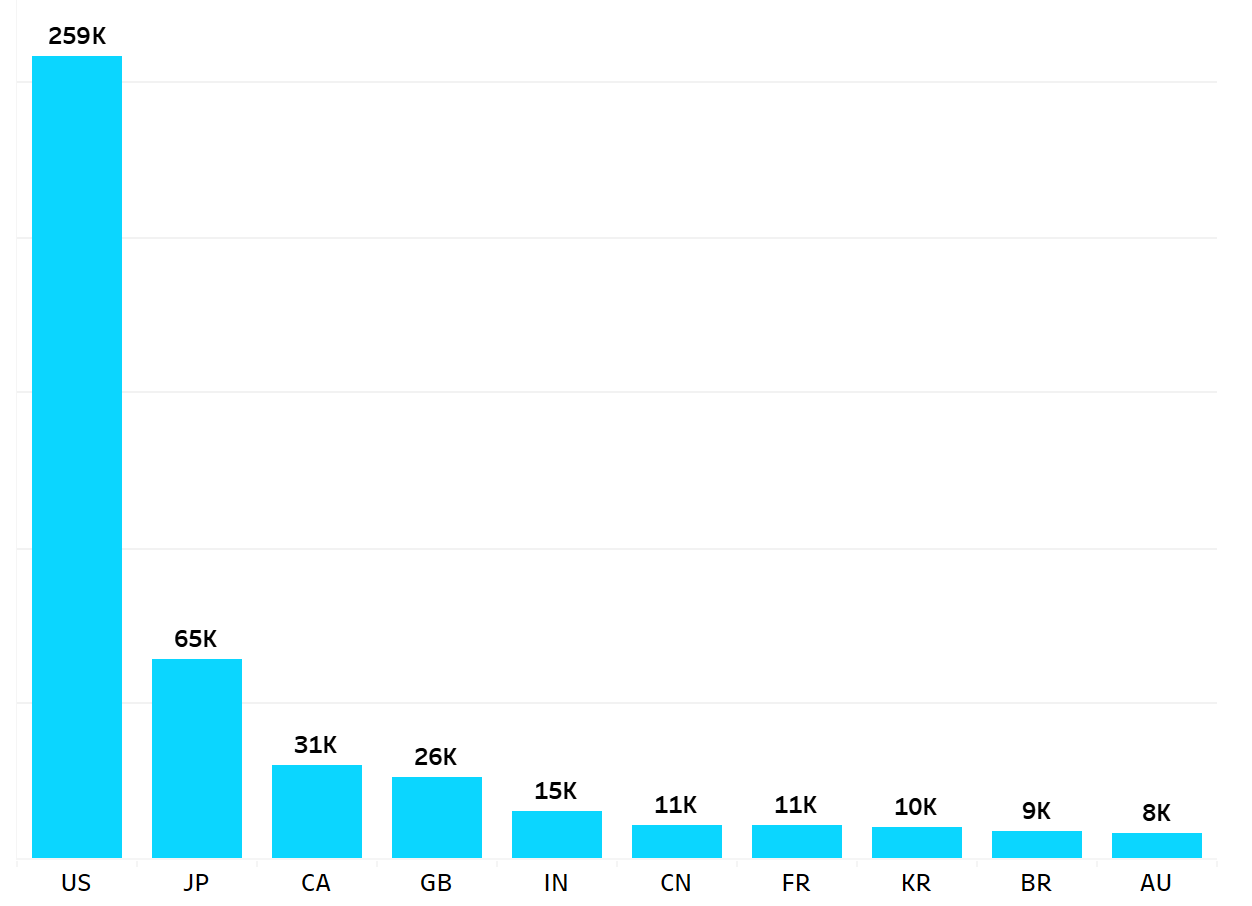
Top 10 countries with the highest number of restaurants being part of the group
The US is the clear leader with over 259K of restaurants belonging to a group. Japan is the second largest groups market but with 4 times less restaurants in groups than the US (65K). Canada has over 31K, and the United Kingdom 26K respectively, India takes the 5th place with15K of restaurants belonging to a group. China and France have similar number of group restaurants, while all the other countries are no more than 10K.
We will review top 5 countries, and look at their most interesting groups characteristics.
The United States:
Due to the large size of consumer market, being a pioneer of franchising, and often car centric suburban development, restaurant groups are taking up a quarter of restaurant space in the country.
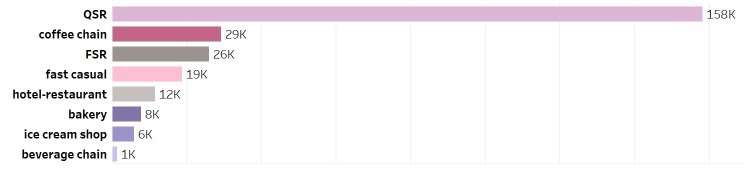
The US: types of groups distribution
- Groups represent 25% of the market.
- 98% of chains are domestic.
- 61% of groups are QSRs, led by Subway, McDonald's, and Taco Bell.
- Top Coffee chains are: Starbucks, Dunkin Donuts, Dutch Bros.
- Top FSR chains are: Waffle House (2K), IHOP (1.7K), Applebee's (1.6K).
Japan:
Japan's dense urban population, cultural dining habits, preference for consistent quality, and a strong history of franchising and corporate restaurant groups all encourage the proliferation of FSR chains.
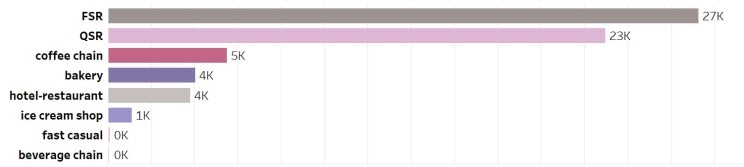
Japan: types of groups distribution
- Market is dominated by FSRs, and mainly domestic: it is led by Skylark (2.6K), Ichibanya (1.3K), Monteroza (1.2K), Saizeriya (1K), and Ohsho (719).
- The second-largest group market globally.
- 90% of chains are domestic.
Canada:
Canada is dominated by domestic group brands (51% of all restaurants in groups). As mentioned above, Canada is driven by coffee culture, cross-border U.S. influence, geography that favors standardization, and a strong franchising framework.
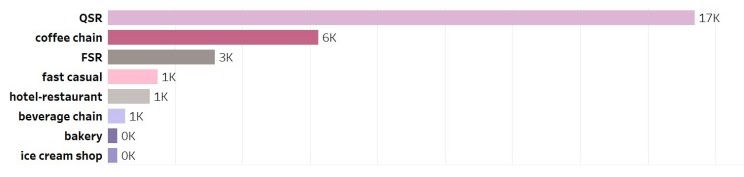
Canada: types of groups distribution
- Market is dominated by QSRs: Subway, McDonald's, A&W, Dairy Queen, Pizza Hut.
- Coffee chains are the second largest category: Tim Hortons, Starbucks.
- FSR space is strongly domestic, led by brands like Boston Pizza (with headquarters in British Columbia, Canada); Swiss Chalet (headquartered in Ontario) with restaurant brands such as Swiss Chalet, Harvey's and The Keg; Cora Breakfast and Lunch (Montreal, Canada).
The United Kingdom:
The UK comes fourth in the number of restaurants belonging to a group.
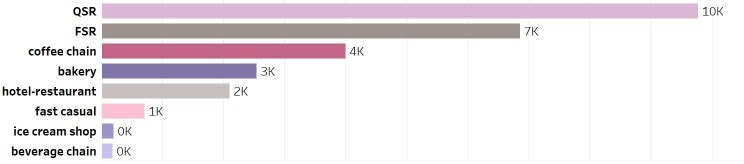
The UK: types of groups distribution
- 58% of UK groups are domestic, followed by US brands (37%), and South African with 4%
- QSRs dominate the market with Subway, McDonalds, and Dominos.
- FSRs are the second largest type of groups with over 7K of restaurants. Leading FSR brands are Greene King (965), JD Wetherspoon (796), Craft union pubs (444 restaurants respectively).
India:
India with its high population is very accustomed to restaurant groups. 7% or 15.4K of restaurants are a part of a group of 20+ restaurants. The groups here thrive because of urbanization, rising middle-class income, cultural preference for safe and diverse dining options, franchise advantages, and the prestige/reliability of hotel-based dining.
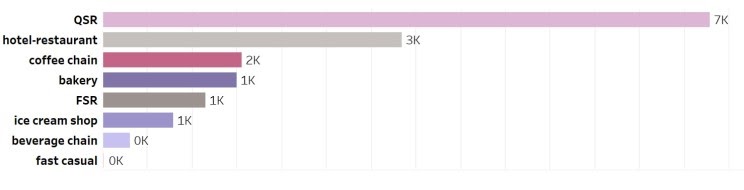
India: types of groups distribution
- 64% of groups are domestic, 31% U.S.-based.
- QSRs' leaders are: Domino's, Subway, Pizza Hut, KFC (601), alongside strong domestic players like Wow! Momo and The Belgian Waffle Co.
- Hotels play a major role as restaurant groups: Indian OYO Rooms (1K), US-based Marriott (300+ locations), Indian Taj Hotels (300+), Indian FabHotels (200+).
- FSRs are mostly domestic, led by Barbeque Nation and Bikanervala.
Reservation platforms preferred by groups
Among full-service groups, reservation platforms remain underutilized: just 27% or 22K of FSR group-owned restaurants use them.
Market leaders include:
- Of all FSRs that use a reservation platform, OpenTable (the US company) is used by 17%.
- 11% use QSR Automations (the US company)
- 10% use Rakuten Gurunavi (Japan company).
For reservation software companies, groups represent attractive but slow-moving clients: scalable, long-term, but requiring complex decision-making.
While restaurant groups are only 10% of the entire restaurant industry, they continue to grow in many parts of the world. The future is likely similar to what it is today with a hybrid landscape: big chains for fast, and reliable dining; small independents for unique experiences and trends.
The data is prepared and collected by analytics.restaurant using public records from Google, Yelp, TripAdvisor, OpenTable, Resy, Tock, QSR Automation and others, 2025.